Posts

Showing posts with the label Sugar Processing

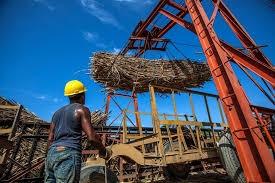
Sugar canes preparation for sugar juice extraction
Image
Preparation of sugar canes takes place in a Pre-mill section in sugar processing industries. Preparation involves; cutting sugar canes into small pieces by cutters and shredders. This prepares sugar canes for milling to ensure maximum extraction of juice from the canes. Reducing sugar canes into small pieces increases their surface area hence enables the mills to press them against each other to extract maximum sugar juice. In most sugar processing industries, there are two cutters or shredders (first and second). The first cutter deals with cutting sugar canes into small pieces. On the other hand, second cutter tenders or masks the sugar canes into sugar cane fibres. Main and Auxiliary Cane Carriers transport sugar canes from pre-mills to mills. Auxiliary Cane Carrier starts from the Cane Tables. The Main Cane Carrier commences from cutters (1 and 2). Along the Main Cane Carrier from cutter two, there is a presence of permanent magnet which traps any magnetic materials tha...

Sedimentation(Settling) in Sugar Processing Industry

Image
Sedimentation is the process where solid substances such as sand, stones, organic materials etcetera are carried to the bottom of the liquid in question (water, sugar juice, milk and so on) where they accumulate and lead to the formation of the solid layer. There are three important methods of sedimentation. They include; centrifugal sedimentation, electrostatic precipitation, and gravity sedimentation or settling out. This article discusses a type of the gravity sedimentation, which is the separation of materials by the use of the earth gravity. It separates dust, emulsions, and suspension. It is often employed in the partial separation of  homogeneous  systems. Gravity sedimentation involves placing a feed that composed of substances (dust, suspension or emulsion) to be separated in a vessel or a tank, and the separated materials are given appropriate time to settle at the bottom. The industrial settlers are grouped into three classes, that is, settlers for; suspe...

appreciating the world of chemistry and biochemistry : Mass Balance In Juice Treatment(Sugar Processing I...

appreciating the world of chemistry and biochemistry : Mass Balance In Juice Treatment(Sugar Processing I... : In Sugar Processing industry, after clarification in clarifier, mass balance commence(the first recycling scheme in sugar processing industr...

Mass Balance In Juice Treatment(Sugar Processing Industry)

In Sugar Processing industry, after clarification in clarifier, mass balance commence(the first recycling scheme in sugar processing industry), when the juice remained in the mud/sediments are recycled to the fresh incoming juice in the mills section. If 40,000 liters/hour of juice is charged in the process, and it is indicated that 90% of the juice overflows to the evaporators as clear juice from clarifier, and in the clarifier, 5% of clear juice overflow after addition of floculant. Now you are required to calculate the rate  flow of the recycled juice. That is juice that is recycled from rotatory vacuum filter to the mills. For you to solve this problem, first you have to draw the diagram(if you can figure it in your head then it's ok) with all available information and unknown which in this case is the amount of juice recycled to the mills to be mixed with fresh mills for the next processing. Then calculate the amount of expected product to be formed(clear juice). Write equa...

Sugar Processing Industry-Juice Treatment

It is very important if you know how sugar cane juice is treated in sugar processing industry. First and foremost lets understand what sugar in the market is. Commercial sugar is a type of carbohydrate called dissacharide(sucrose). It is a compound that is formed from one molecule of glucose and one molecule of fructose joined by a glycosidic bond at alpha-1-carbon of glucose molecule to 2-beta carbon of fructose molecule. This means that sucrose is a non-reducing sugar. Why? because there is no free reducing ends on both glucose and fructose molecules  that can accept the electrons to be reduced, all are utilized in the formation of the glycosidic bond, that is keto- group at carbon number two of fructose and aldehyde group at carbon number one of glucose molecule. Don't  get confused when I talk about alpha- or beta- I'm just referring to the orientation of the hydroxyl groups(anomeric hydroxyl group) at carbon number one of glucose or carbon number two of fructose, when hyd...