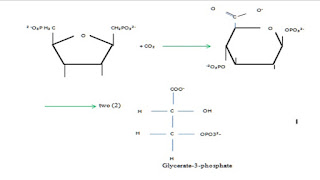
In this stage carbon (IV) dioxide from atmosphere is captured and modified by addition of hydrogen to form carbohydrates and other organic compounds (amino acids and lipids). Carbon (IV) dioxide combines with ribulose-1, 5-bisphosphate to form unstable six carbons sugar which eventually breaks down to two (2) molecules of glycerate-3-phospahte, check it here; Two molecules of glycerate-3-phospate are phosphorylated by ATP to form two (2) molecules of glycerate disphosphate, NADPH catalyzes them, reducing them to two molecules glyceraladehyde-3-phospate. One molecule of glyceraldehyde-3-phosphate is quickly converted to glucose, amino acids, lipids and other carbohydrates while the other molecule is utilized in the synthesis of ribulose-1,5-bisphospahte. This process is as follow; In this process, first stable molecule is glycerate-3-phosphate . Energy carriers (ATP and NADPH) are used to reduce glycerate-3-phosphate to form 12 mo...

this gentleman think electrolysis can be the best method. Read this!!
ReplyDeletehere's a light bulb moment.
if you do a 2 stage process, electrolysis can separate the water into hydrogen and oxygen without effecting the glycerol.
here's why:
for electrolysis separation to occur, the substance you wish to separate must be an electrolyte.
water is an electrolyte, but glycerol (aka glycerin) is not.
so the water will turn to gas while the glycerol stays in it's molecular form.
how to separate the salts is, to me, undiscovered.
however, if you need an extremely dry, air tight chamber for testing electrostatic experiments, this is simple and cheep.
it only takes a few but no more than 12 volts DC to do so.
car battery anyone?
if you'd like, the gases released from this process are hydrogen and oxygen, so if you filter out the hydrogen and fuel your hydrogen fuel cell car then you're really got it good!